

Best Water Temperature for Brewing Green Tea
Quick Summary
The best water temperature for brewing green tea is roughly 160-180°F (71-82°C), well below boiling. Cooler water pulls out the sweet, savory amino acids before the bitter catechins, giving a smoother, more balanced cup. Start near 170°F and adjust by leaf grade.
- Let boiled water cool before pouring; full boiling water makes green tea bitter.
- Delicate Chinese greens and Japanese sencha suit 160-175°F, per the chart.
- Sturdy leaves like gunpowder can handle 170-180°F for 2-3 minutes.
- If a cup tastes bitter, lower the temperature 10-15°F and shorten the steep.
- If a cup tastes weak, add steep time in 30-second increments rather than more heat.
Table of Contents
- Why Green Tea Is Brewed Below Boiling
- Green Tea Temperature Chart by Type (Fahrenheit and Celsius)
- Green Tea Water Temperature Fahrenheit: Matching Heat to Leaf Grade
- Green Tea Brew Temperature and Time Together
- Jasmine Green Tea Water Temperature and Multiple Steepings
- Green Tea Steep Time: How Long to Leave the Leaves
- Taste Troubleshooting: Bitter, Flat, or Weak Cups
- Start Brewing Your Next Cup at the Right Temperature
- Frequently Asked Questions
Why Green Tea Is Brewed Below Boiling
Green tea is brewed well below boiling because its leaves are delicate and unoxidized. The compounds that make a cup taste sweet and savory, amino acids like L-theanine, which reads as umami and a soft mouthfeel, extract readily at moderate heat. The compounds that make it taste bitter and astringent, catechins and caffeine, extract faster as water gets hotter. Push water toward 212°F (100°C) and the bitter, astringent side of that race wins before the sweet, savory side has finished. Pull the temperature down to roughly 160-180°F (71-82°C) and the extraction order flips in your favor: the amino acids come out first, the catechins lag, and the cup reads smoother and more balanced.
That is the mechanism behind the common advice. It also explains why the advice is a range rather than a number: leaf grade, harvest timing, and processing all shift where the balance point sits. A tender early-pick leaf has more to lose from heat than a large, rolled, later-pick leaf.
Our recommendation is to let boiled water cool before pouring. A Specialty Tea Association brewing guidance describes the same principle for most green teas: lower temperatures protect the leaf.
A repeatable no-thermometer cooling method. Most home brewers do not own a variable-temperature kettle, and "let it cool a few minutes" is too vague to repeat. This method is built around a standard 8-ounce cup and a stovetop or electric kettle, and it accounts for the two variables that change cooling speed most: water volume and vessel type.
- Boil a measured amount. For one cup, boil about 10 ounces, a little more than you need, so you can pour off the hot water and still fill your cup. A full kettle cools much more slowly than a small one; if you boil a liter, add roughly 50% to every time below.
- Pre-warm the vessel, then empty it. Swirl hot water in your mug or teapot for a few seconds and dump it. A cold ceramic mug pulls heat out of the water fast and makes your timing unpredictable.
- Pour and wait by vessel type. In a thin-walled glass or a pre-warmed ceramic mug, 10 ounces of just-boiled water reaches roughly 175°F in about 4-5 minutes and roughly 165°F in about 6-7 minutes at room temperature. A thick-walled ceramic teapot holds heat longer, add 1-2 minutes to each target. A metal pot sheds heat faster, subtract about a minute.
- Use the touch test as a cross-check. Touch the outside of the vessel. If it is too hot to hold comfortably for more than a second, you are likely still above 180°F. If you can rest your hand on it, you are in the 160-175°F band. This is not precise, but it catches the common error of brewing far too hot.
- Pour from height for a final nudge. Transferring water from the kettle into a second vessel, or pouring from a few inches above the cup, drops the temperature another 5-10°F through aeration and heat loss. Use this to fine-tune downward without waiting longer.
Watch out: these timings assume still, uncovered water at ordinary room temperature. A lid on the kettle, a cold kitchen, or a large volume of water will all push the numbers, so treat the times as a starting point and taste at the low end first.
Green Tea Temperature Chart by Type (Fahrenheit and Celsius)
Not all green teas call for the same temperature. Leaf grade, roast level and harvest all change the ideal range. Use this chart as a starting point:
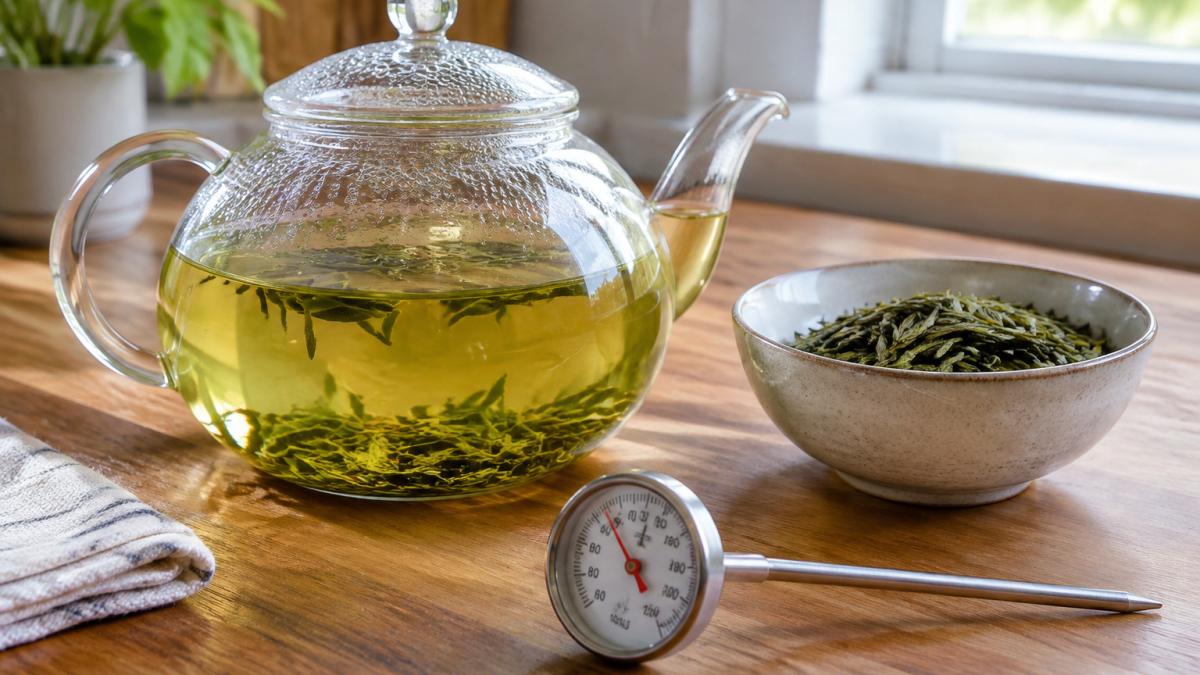
| Green Tea Type | Water Temperature (°F) | Water Temperature (°C) | Typical Steep Time |
|---|---|---|---|
| Delicate Chinese green (light, floral) | 160-170°F | 71-77°C | 1-2 minutes |
| Japanese sencha | 160-175°F | 71-79°C | 1 minute |
| Gunpowder (rolled, strong) | 170-180°F | 77-82°C | 2-3 minutes |
| Hojicha (roasted) | 180-190°F | 82-88°C | 1-2 minutes |
Typical Steep Time
Treat these as guidelines, not rules. Start at the low end and adjust to your taste.
Green Tea Water Temperature Fahrenheit: Matching Heat to Leaf Grade
Higher-grade leaves are more tender and need cooler water. Lower-grade or larger, rolled leaves can handle a little more heat without turning bitter. If you are unsure of your tea's grade, start near 170°F (77°C) and adjust with the next cup.
Green Tea Brew Temperature and Time Together
Temperature and steep time are two dials on the same extraction. Heat drives how fast the leaf gives up its compounds; time controls how long that extraction runs. Turn one up and you usually need to turn the other down. A cup brewed at 165°F for two minutes and a cup brewed at 180°F for one minute can land in a similar place, though the hotter, shorter cup tends to show more aroma and less body, while the cooler, longer cup reads rounder and sweeter.
Use this matrix as a starting point for a standard 8-ounce cup with about one teaspoon (roughly 2-3 grams) of loose leaf. The cells show steep time at each temperature band; the notes explain what changes. For a full walkthrough of brewing loose leaf tea properly, see Best Ways to Brew Loose Leaf Tea.
| Temperature band | Delicate leaf (light Chinese greens, early-pick sencha) | Mid-grade leaf (standard sencha, jasmine green) | Sturdy leaf (gunpowder, hojicha, bancha) |
|---|---|---|---|
| 160-165°F (71-74°C) | 2:00-2:30, sweet, floral, low bitterness | 1:30-2:00, soft, may taste thin | 1:00-1:30, likely weak; not the right band |
| 170-175°F (77-79°C) | 1:15-1:45, brighter, still smooth | 1:00-1:30, balanced everyday cup | 1:00-1:30, clean but under-extracted |
| 180-185°F (82-85°C) | 0:45-1:00, risks astringency; watch closely | 0:45-1:00, brisk, less sweet | 1:00-2:00, full body, toasty notes |
| 190-200°F (88-93°C) | Not recommended for delicate leaf | 0:30-0:45, only if you want a sharp cup | 0:45-1:30, works for roasted styles |
Three rules make the matrix usable in practice:
- Change one dial at a time. If a cup is close but not quite right, adjust steep time in 15-second steps before you touch temperature. Temperature shifts change the character of the extraction; time shifts change its strength. Fixing strength first keeps you from chasing flavor with heat.
- Hotter and shorter beats hotter and longer. If you must brew above 180°F, say, because your kettle only has one setting, cut the steep to under a minute and taste at 45 seconds. The most common harsh, grassy cup comes from hot water left on delicate leaf past the one-minute mark, not from the temperature alone.
- Scale time to leaf quantity, not just temperature. A heaped teaspoon extracts faster than a level one. If you add leaf, shorten the steep rather than cooling the water further; otherwise you trade bitterness for a thin, over-diluted cup.
Watch out: the matrix assumes fresh, properly stored leaf and filtered water. Stale leaf or hard, heavily mineral water can flatten a cup no matter how carefully you pair temperature and time, so rule those out before you blame the numbers.
For multiple infusions, the pairing shifts. The first steep at 165-170°F for about 90 seconds sets a gentle baseline. On the second and third steeps, most practitioners raise the water 5-10°F and add 15-30 seconds, because the leaf has already given up much of its easiest-extracted material. A typical progression for a mid-grade sencha looks like this: 170°F for 1:30, then 175°F for 1:45, then 180°F for 2:00. Delicate Chinese greens often stop rewarding you after two steeps; sturdy rolled and roasted leaves can go three or four. Taste between steeps and stop when the cup goes flat, that is the leaf telling you it is spent, not a sign you brewed it wrong.
Jasmine Green Tea Water Temperature and Multiple Steepings
Our Jasmine blends a fine green tea base with freshly plucked jasmine blossoms.
The leaves hold up to several infusions.
Green Tea Steep Time: How Long to Leave the Leaves
Most green teas do best with one to three minutes of steeping. Taste at one minute first. If the cup is weak, add time in 30-second increments rather than raising the temperature. Adding time usually improves flavor without introducing bitterness.
Matcha is whisked rather than steeped, so timing does not apply in the same way.
Taste Troubleshooting: Bitter, Flat, or Weak Cups
If your green tea tastes bitter, lower the water temperature by 10-15°F and shorten the steep. If it tastes flat or weak, add a little more leaf or steep slightly longer at the same temperature. Stale leaves also produce flat cups, regardless of how well you brew them. Learn how to store tea leaves properly so they stay fresh.
Check your leaves before adjusting your technique. Learn how to tell whether tea leaves are of good quality. Fresh, properly stored tea responds predictably to small changes in temperature and time.
Start Brewing Your Next Cup at the Right Temperature
Start with 170°F (77°C) for most green teas, then adjust by type and taste. For ideas on choosing a high-quality blend to gift or explore next, see Artisanal Tea Blends. Our Matcha is priced at $22.99, and our Moroccan Mint, Hojicha and Jasmine are also $22.99 each.


Frequently Asked Questions
How hot should water be to brew green tea?
Most green teas brew best between 160 and 180°F (71 to 82°C), well below boiling at 212°F (100°C). Delicate, high-grade leaves like gyokuro or sencha sit at the lower end, while sturdier leaves such as bancha tolerate the upper range. Boiling water scorches the leaves and releases bitter compounds, so let kettle water rest a few minutes or cool it before pouring. A basic thermometer makes it easy to hit the right number consistently.
What is the best water temperature for green tea in Fahrenheit?
For most everyday green teas, aim for 170 to 180°F. Lighter, more delicate varieties do best at 160 to 170°F, and robust roasted or bagged teas can handle 180°F. The green tea water temperature Fahrenheit guideline in this article gives a type-by-type chart so you can adjust without guessing. Start at the middle of the range and move up or down based on how the cup tastes.
Can you brew green tea without a thermometer?
Yes. Bring water to a full boil, then pour it into a mug or pitcher and wait about 2 to 3 minutes before adding the leaves. Water that is steaming but not rolling bubbles usually lands near 175 to 185°F. For a more repeatable method, pour the boiled water into a second vessel, let it sit for a set time, and note how long your favorite tea takes to reach the target. Consistent timing will get you close enough for most cups.
Does water temperature affect green tea's flavor?
Yes, temperature has a strong effect on flavor. Cooler water extracts sweetness and umami from green tea, while very hot water pulls out tannins that taste bitter or astringent. If your cup tastes harsh, lower the temperature by 10 to 15°F before changing anything else. If it tastes thin or grassy, raise the temperature slightly or steep a little longer. Adjusting temperature and steep time together gives the most control over the final cup.
