

9 Benefits of Loose Leaf Green Tea You Should Know
Last Updated: October 30, 2026
Quick Summary
Drinking loose leaf green tea gives you more control over flavor and strength, since you can adjust the leaf amount, water temperature, and steeping time. Whole leaves unfurl during steeping, producing a fuller, more layered cup than a tea bag. Green tea is also rich in catechins, plant compounds often described as antioxidants.
- Loose leaves unfurl during steeping, which tends to produce a fuller, more layered cup.
- You can change leaf amount, water temperature, and steeping time, unlike a fixed-dose tea bag.
- Brew at about 175 degrees Fahrenheit for 2 to 3 minutes, using about 1 teaspoon per 8 ounces.
- Store loose leaf green tea in an airtight container away from light, heat, and strong odors.
Table of Contents
- What Makes Loose Leaf Green Tea Different
- Loose Leaf Green Tea vs Tea Bags: Does the Difference Matter?
- Antioxidants and Catechins in Green Tea
- Heart, Brain, and Metabolic Health: What the Research Shows
- Green Tea Caffeine Content and Realistic Daily Intake
- Green Tea Side Effects, Medication Interactions, and Who Should Be Cautious
- How to Brew Loose Leaf Green Tea for Better Flavor and Compounds
- Choosing and Storing Your Next Loose Leaf Green Tea
- Frequently Asked Questions
What Makes Loose Leaf Green Tea Different
Loose leaf green tea is simply green tea sold as whole or large leaves rather than fine particles packed into a bag. That distinction matters because the leaf has more room to unfurl during steeping, which tends to produce a fuller, more layered cup. theITDGroup LLC carries loose leaf options, including Matcha, which is a different preparation altogether: the whole leaf is ground into a powder and whisked into the water rather than steeped and strained out.

For most drinkers, the practical differences come down to three things: flavor depth, freshness, and control. Whole leaves let you adjust strength by changing the amount of tea, the water temperature, and the steeping time. A bagged tea gives you one fixed setting.
Watch out: Green tea that has been stored in a warm, bright, or humid place can taste flat or grassy within weeks, so storage matters as much as the product itself.
Loose Leaf Green Tea vs Tea Bags: Does the Difference Matter?
Yes, and the difference is more mechanical than mystical. The two products are the same plant, but they are graded, processed, and brewed differently, and those differences show up in the cup.
Leaf grade and particle size. Tea bags typically contain fannings or dust, small broken leaf fragments left over from sorting whole leaf. Loose leaf green tea is sold as whole leaf, broken leaf, or large pieces, depending on the style. Particle size matters because extraction is a surface-area problem: smaller particles expose more leaf surface to water, so they release soluble compounds faster. That is convenient when you want a strong cup in 60 seconds, but it also means bitter tannins arrive at the same time as the aromatics, and the brewer has less room to separate them.
Room to unfurl. Whole leaves expand as they hydrate. In a roomy infuser or gaiwan, the leaf opens and water circulates around it, which produces a more layered extraction, aroma first, then sweetness, then astringency on later infusions. A cramped bag restricts that expansion, so the same leaf weight can taste flatter. This is the practical reason many drinkers report that loose leaf tastes "more like tea" even when the cultivar is identical.
Freshness and volatile aromatics. The compounds responsible for green tea's fresh, vegetal aroma are volatile, they fade with exposure to air, light, and heat.
Control over the brew. A bag is a fixed dose. Loose leaf lets you change leaf-to-water ratio, water temperature, and steeping time independently, and it supports multiple infusions from the same leaves. That control is the main reason experienced drinkers switch, and it is also why loose leaf is the better format if you want to taste differences between teas rather than just drink a mild hot beverage.
Where bags still win. Convenience, consistency, portion control, and cleanup. If you want a predictable cup at your desk with no measuring, a good-quality bag is a reasonable choice. The trade-off is ceiling, not floor: a bag can be perfectly pleasant, but it gives you fewer levers to pull.
Watch out: Green tea that has been stored in a warm, bright, or humid place can taste flat or grassy within weeks, so storage matters as much as the product itself.
Antioxidants and Catechins in Green Tea
Green tea is rich in polyphenols, a family of plant compounds, and the best known of these are catechins. The most studied catechin is epigallocatechin gallate, usually abbreviated EGCG. Catechins are the reason green tea is often described as high in antioxidants, which are compounds that help neutralize unstable molecules in the body.
It helps to be precise about what this means. Antioxidant content in a cup depends on the tea, how it was processed, and how it was brewed, so the number on a label should not be read as a guaranteed dose.
Heart, Brain, and Metabolic Health: What the Research Shows
The most useful way to read this section is by evidence type: laboratory studies, observational studies in populations, and randomized controlled trials in people. Only the last can support causal claims, and even then the effects are usually modest.
Green Tea Caffeine Content and Realistic Daily Intake
A common approach is to start with one or two cups a day and notice how you feel, especially if you are sensitive to caffeine.
Green Tea Side Effects, Medication Interactions, and Who Should Be Cautious
Medication interactions are the area that deserves the most attention. Green tea can interact with certain drugs, including some blood thinners and medications processed by the liver, so anyone on prescription medication should check with a pharmacist or doctor before drinking it regularly. Concentrated green tea extracts carry higher risk than brewed tea and are not the same thing as a cup of tea.
How to Brew Loose Leaf Green Tea for Better Flavor and Compounds
Use water that is hot but not boiling, roughly 160 to 180 degrees Fahrenheit, because water at a full boil scorches the leaves and produces a bitter, grassy cup.
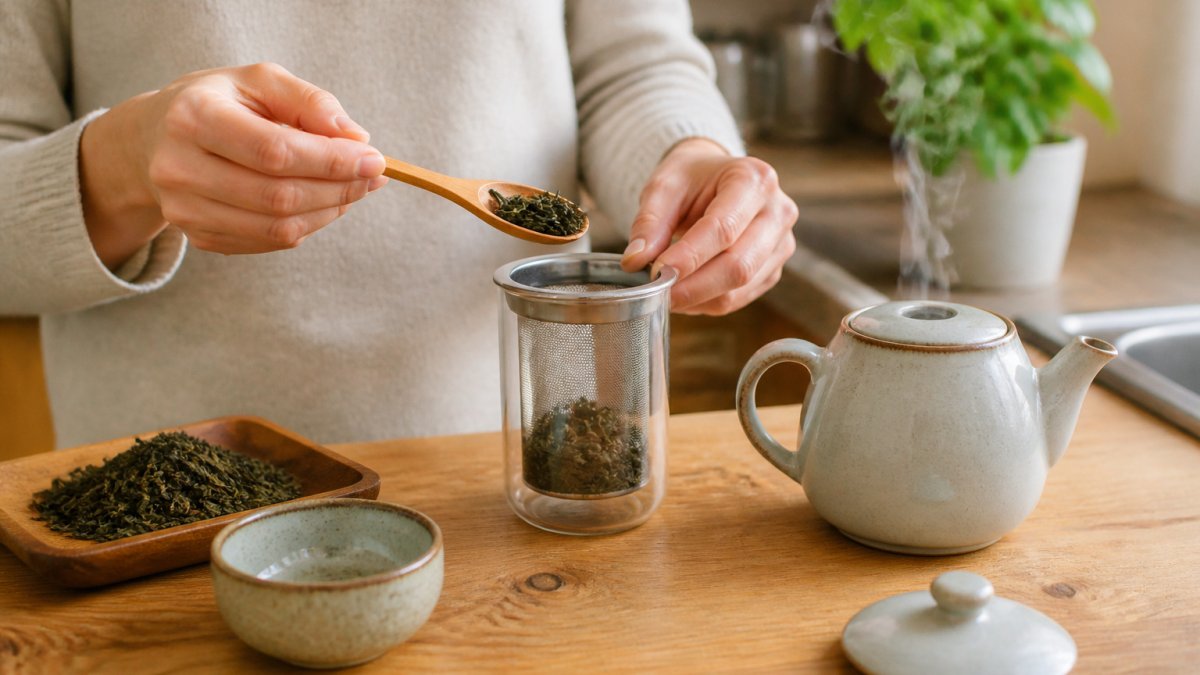
A practical method:
- Use about 1 teaspoon of loose leaf per 8 ounces of water.
- Heat the water to around 175 degrees Fahrenheit.
- Steep for 2 to 3 minutes, then taste and adjust.
- Remove the leaves promptly, or a second steep will turn bitter.
!Close-up of hands spooning loose green tea leaves into a glass infuser beside a steaming ceramic teapot on a wooden kitchen counter
The article gives a simple starting method for brewing loose leaf green tea.
| Step | What to do | Time or amount |
|---|---|---|
| Measure leaves | Use loose leaf tea per cup | About 1 teaspoon per 8 ounces |
| Heat water | Bring water to hot, not boiling | Around 175°F (160-180°F range) |
| Steep | Steep the leaves, then taste | 2 to 3 minutes |
| Remove leaves | Take the leaves out promptly | Before the cup turns bitter |
Choosing and Storing Your Next Loose Leaf Green Tea
When choosing loose leaf green tea, look for a clear description of the origin, the harvest or production date, and a tasting note that matches what you enjoy. A practical guide to judging loose tea quality walks through what to check before you buy. Tea that is fresh and well stored tastes brighter, so buying in smaller quantities more often usually beats buying a large bag that sits for months.
Store your tea in an airtight container, away from light, heat, and strong odors. Learn how to keep loose tea fresh after purchase with more practical storage advice. A cool, dark cabinet works well. If you are curious about a different style, Moroccan Mint and Jasmine are blends built on a green tea base, so you can compare how the leaf changes with the addition of other ingredients.


Frequently Asked Questions
What are the health benefits of green tea?
Green tea contains polyphenols, especially catechins such as epigallocatechin gallate (EGCG), which are studied for their antioxidant activity. Observational and clinical research has linked regular green tea intake with modest associations with heart health, blood cholesterol and blood pressure, and weight management. The evidence is stronger for some outcomes than others, and green tea should be seen as part of a balanced diet rather than a treatment for any condition.
Does loose leaf green tea have more health benefits than tea bags?
Loose leaf tea generally contains larger leaf pieces than the fannings or dust typically used in tea bags, and it often reflects fresher, less processed leaf. Those differences can affect flavor and how completely compounds are released during steeping. Direct clinical comparisons of loose leaf versus bagged green tea are limited, so claims that loose leaf produces specific health outcomes should be treated cautiously.
How much caffeine is in loose leaf green tea?
Caffeine content varies with the leaf grade, the amount used, water temperature, and steeping time. A typical 8-ounce cup of green tea contains roughly 25 to 50 milligrams of caffeine, well below the amount in a cup of brewed coffee. Most healthy adults can enjoy several cups a day, but people sensitive to caffeine should monitor their intake and consult a doctor if they are pregnant or have a heart condition.
Can drinking green tea every day cause side effects?
Daily green tea is safe for most adults in moderate amounts, but high intakes of green tea extract supplements have been linked to liver problems in some case reports. Caffeine can cause insomnia, jitteriness, or stomach upset, and green tea can interfere with the absorption of iron. People taking blood thinners or other medications should check with a healthcare provider before making green tea a daily habit.
