

Single Origin Tea Flavor Profiles Explained
Table of Contents
- Single Origin Tea Flavor Profiles Explained: A Complete Guide
- What Is Tea Terroir and Why It Defines Every Cup
- How Processing Methods Shape Single Origin Tea Flavor
- Cultivar, Flush, and Leaf Grade: The Variables Behind Every Sip
- How to Taste Tea Like a Professional
- Single Origin vs Blended Tea: Which Should You Choose?
- Water Chemistry, Brewing Parameters, and Sustainability
- Frequently Asked Questions
Last Updated: October 4, 2026
Single Origin Tea Flavor Profiles Explained: A Complete Guide
Single origin tea flavor profiles explained simply come down to one idea: where a tea is grown and how it is processed determines what you taste. A Darjeeling first flush and a Japanese hojicha can both be Camellia sinensis, yet share almost nothing in the cup.

This guide breaks down terroir, processing, cultivar, and brewing so you can read a label and know what you are buying.
What Is Tea Terroir and Why It Defines Every Cup
Tea terroir is the combined effect of soil, elevation, climate, and microclimate on a tea plant's chemistry, the single largest driver of flavor before processing begins. Two gardens a few miles apart can produce measurably different leaf.
Elevation, Microclimate, and Soil
Higher elevation generally means cooler air, slower leaf growth, and more concentrated aromatic compounds. Mist and cloud cover diffuse sunlight, which many growers associate with softer tannins and a more layered aromatic profile. Soil mineral content and drainage also shape nutrient uptake, showing up as distinct notes in the cup.
A common mistake is assuming elevation alone guarantees quality: a well-managed low-elevation garden can outperform a poorly handled high-altitude one.
How Processing Methods Shape Single Origin Tea Flavor
Processing decides how much of the leaf's potential to preserve or transform. The same green leaf can become grassy, floral, or deeply earthy depending on withering, rolling, oxidation, and firing.
Oxidation Levels and Their Impact
Oxidation is the controlled browning of leaf enzymes after rolling. Lower oxidation preserves green, vegetal notes; higher oxidation builds tannins, malt, and dried-fruit character. Firing locks the profile in place.
| Oxidation Level | Typical Style | Flavor Direction | Example Notes |
|---|---|---|---|
| Minimal | Green tea | Fresh, vegetal | Grassy, umami |
| Partial | Oolong | Floral, creamy | Floral, muscatel |
| Full | Black tea | Bold, structured | Malt, tannins |
That table is the fastest way to predict a cup before you brew it: know the oxidation level and cultivar, and you can guess the aromatic profile with reasonable accuracy.
Cultivar, Flush, and Leaf Grade: The Variables Behind Every Sip
Cultivar is the plant variety, flush is the harvest timing, and leaf grade is the physical selection of leaves. Together they explain why two teas from one estate can taste completely different.
Cultivar: The Genetic Flavor Baseline
A cultivar is a cultivated variety of Camellia sinensis, propagated for specific traits: aroma, cold hardiness, yield, or disease resistance.
Named cultivars carry predictable tendencies:
- Yabukita, the dominant Japanese cultivar, roughly 70% of Japanese tea acreage. Clean, grassy, high in theanine; the reference point for sencha.
- Saemidori, a Japanese cultivar prized for deep green liquor and low astringency; common in high-grade sencha and kabusecha.
- Benifuuki, a Japanese cultivar high in methylated catechins; distinctly bitter and used for specific health-positioned teas.
A single cultivar grown in two places will not taste the same: Yabukita in Shizuoka and Kagoshima share a family resemblance but diverge in sweetness and umami because of terroir. Cultivar sets the range; terroir and processing decide where inside it the cup lands.
Flush: Seasonal Windows and What They Do to Flavor
A flush is a growth period, the push of new shoots after dormancy or pruning. Flush timing shifts leaf chemistry: cooler, slower growth concentrates amino acids and aromatics, while warm, fast growth builds catechins and body.
- First flush (spring): The first new shoots after winter dormancy. Lower yield, higher concentration of theanine and aromatics. In Darjeeling, first flush is picked from roughly late February through mid-April and is famous for its light body, greenish liquor, and muscatel/floral notes. In Japan, the first flush (shincha, then ichibancha) is the most prized sencha window, typically late April through May.
- Second flush: Picked roughly May through June in Darjeeling. Warmer weather and the greenfly insect cycle are associated with the rounder, fruitier, more full-bodied character many buyers prefer over first flush. In Japan, nibancha (second flush) is noticeably more astringent and less sweet than ichibancha.
- Autumn flush / autumnal: Picked after the monsoon. In Darjeeling this is the autumnal flush (roughly October-November), producing darker, smoother, less aromatic liquor than spring or second flush. In Japan, shuutoubancha (fall bancha) is coarser and lower in theanine.
For a buyer, "Darjeeling" alone is not a flavor: a first flush and an autumnal flush from the same garden can taste like two different teas, and the price gap reflects that.
Leaf Grade: Physical Selection and What It Predicts
Leaf grade describes which leaves were plucked and how they were sorted. It is the most reliable predictor of mouthfeel and steeping endurance, and the least reliable predictor of flavor quality alone.
- Whole-leaf grades, buds and the top two leaves, intact. Cleaner infusion, slower extraction, more infusions per serving. Examples: FTGFOP (Finest Tippy Golden Flowery Orange Pekoe), SFTGFOP, and the Japanese needle-style grades used for gyokuro and high-grade sencha.
- Broken grades, leaf pieces rather than whole leaves. Faster extraction, brisker and stronger cup, fewer infusions. Examples: BOP (Broken Orange Pekoe), BP (Broken Pekoe).
- Fannings and dust, very small particles used almost exclusively in tea bags. Fast, strong, and one-dimensional; they extract fully in a single steep.
The common mistake is treating grade as a quality ladder. A whole-leaf grade from a poorly managed garden can be duller than a well-made broken grade from a great one.
- Cultivar: genetic flavor baseline, sets the range of aromatics and body
- Flush: seasonal character and intensity, shifts sweetness, astringency, and aroma concentration
- Leaf grade: mouthfeel, clarity, and steeping endurance, predicts extraction behavior, not quality
How to Taste Tea Like a Professional
Professional tasting is a repeatable method, not a talent. It relies on consistent leaf weight, water temperature, and steep time so differences you detect come from the tea, not your process.
Cupping and Sensory Analysis at Home
Use a small white bowl or cup to judge color and clarity. Weigh your leaf, use freshly boiled water cooled to the right temperature, and steep for a fixed time.
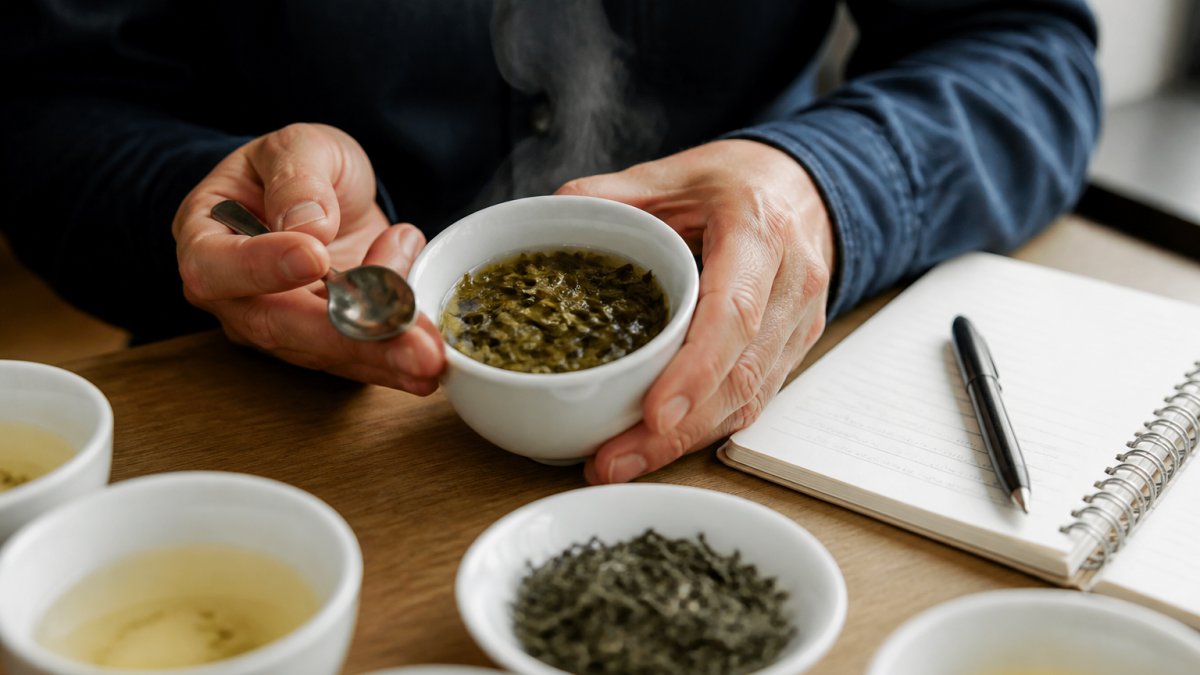
Score each tea on these dimensions:
- Aroma: floral, earthy, muscatel, grassy
- Mouthfeel: body, smoothness, astringency
- Finish: length and how it evolves
For a full sensory breakdown, the Specialty Tea Institute cupping standards are worth reading before you build your own scoring sheet.
Single Origin vs Blended Tea: Which Should You Choose?
Single origin tea comes from one garden, region, or harvest, while blended tea combines leaves from multiple sources. Single origin showcases provenance and terroir; blends deliver consistency year after year.
Choose single origin to taste a place and a season; choose a blend for the same cup every morning regardless of harvest variation. Neither is superior; they solve different problems.
| Factor | Single Origin | Blended |
|---|---|---|
| Flavor | Distinct, variable | Consistent, balanced |
| Best for | Exploration | Daily ritual |
| Provenance | Traceable to estate | Mixed sources |
| Year-to-year | Changes with harvest | Stable |
If you want a starting point, our Matcha offers a clean, lingering umami profile for traditional preparation, and our Hojicha brings toasted cereal notes with balanced umami for a gentler daily cup.

Water Chemistry, Brewing Parameters, and Sustainability
"Use good water and the right temperature" is true and useless. The three variables that actually decide whether a single origin tea reaches its potential are water chemistry, origin-specific brewing parameters, and the farming practices behind the leaf.
Water Chemistry: The Variable Nobody Measures
Water is roughly 99% of your cup. Its mineral content, total dissolved solids (TDS) and the balance of calcium, magnesium, and bicarbonate, changes how flavor compounds extract and present on the palate.
- High TDS / hard water: Calcium and magnesium bind to aromatic compounds and to the polyphenols that read as astringency. The result is a muted aroma, a flatter mid-palate, and a harsh, drying finish. Delicate green and white teas suffer most.
- Very soft or distilled water: Almost no minerals means almost no extraction buffer. The cup tastes thin, hollow, and sometimes metallic, because the compounds that carry sweetness and body never fully come out of the leaf.
- Bicarbonate-heavy water (high alkalinity): Raises the pH of the brewing liquor, which suppresses the bright, brisk acids in black tea and pushes green tea toward a dull, cooked-vegetable note.
A practical target is moderate TDS with low alkalinity, enough minerals to extract flavor, not enough bicarbonate to flatten it. If your tap water is very hard, a carbon filter will not fix it; use a softener or a blend of filtered and low-mineral bottled water.
Origin-Specific Brewing Parameters
Generic brewing charts treat all green tea the same and all black tea the same. In practice, the right parameters depend on origin and style, because leaf size, oxidation level, and cultivar chemistry shift the extraction curve.
| Origin / Style | Leaf (per 8 oz) | Water Temp | Steep Time | Notes |
|---|---|---|---|---|
| Japanese sencha (Yabukita) | 1 tsp (~3 g) | 160-175°F | 60-90 sec | Lower temp preserves umami; higher temp pulls astringency |
| Gyokuro | 1 tbsp (~5 g) | 130-140°F | 90-120 sec | Very low temp; long, sweet, umami-heavy liquor |
| Chinese green (Longjing / Dragon Well) | 1 tsp (~3 g) | 170-180°F | 2-3 min | Glass or gaiwan; watch for bitterness past 3 min |
| Darjeeling first flush | 1 tsp (~2.5 g) | 185-195°F | 2-3 min | Treat like a light oolong; boiling water kills the muscatel |
| Darjeeling second flush | 1 tsp (~2.5 g) | 195-205°F | 3 min | Warmer water opens the fruit and body |
| Assam (single estate) | 1 tsp (~2.5 g) | 205-212°F | 3-4 min | Handles near-boiling; add milk only if the estate style supports it |
| Ceylon (high-grown) | 1 tsp (~2.5 g) | 195-205°F | 3 min | Bright, brisk; over-steeping turns it metallic |
| Taiwanese high-mountain oolong | 1 tbsp (~5 g) | 195-205°F | 45-60 sec, multiple infusions | Rolled leaf needs more leaf and shorter steeps |
| Roasted oolong (Tieguanyin, Dong Ding) | 1 tbsp (~5 g) | 200-205°F | 45-60 sec, multiple infusions | Warm water opens the roast without scorching |
| Japanese hojicha | 1 tsp (~3 g) | 185-195°F | 30-60 sec | Low caffeine; short steep keeps the toast sweet rather than ashy |
Two rules sit underneath the table. First, for more intensity, add leaf before time, longer steeps extract harsh tannins faster than aroma. Second, adjust for your water: if it runs hard, drop the temperature 5-10°F and shorten the steep, because hard water already accelerates astringency extraction.
Sustainability and Sourcing: How Farming Practice Reaches the Cup
Sustainability is usually framed as an ethics story. It is also a flavor story, and the two are inseparable.
- Shade-grown tea: Gyokuro and high-grade matcha are grown under shade for roughly 20 days before harvest. Shading slows photosynthesis, which raises theanine and chlorophyll and lowers catechins. That is the direct mechanism behind the sweet, umami-heavy profile, it is not a marketing claim, it is plant physiology.
- Slow growth from altitude and cool nights: The same logic that drives shade-growing also drives high-elevation flavor. Slower leaf growth concentrates amino acids and aromatics. A garden that pushes leaf fast for volume will not produce the same cup, regardless of cultivar.
- Soil management and organic practice: Living soil with active microbial life supports nutrient uptake that shows up as complexity in the cup. Continuous monoculture with heavy synthetic inputs tends to produce flatter, more uniform leaf.
For buyers, the practical link is this: certifications and sourcing claims are proxies for farming practices, and farming practices are direct inputs to flavor. For background on how origin and labor practices intersect, the Fair Trade standards for tea outline the requirements growers meet.
Our Earl Grey shows how bergamot and cornflowers layer over a Ceylon base for orange and floral notes, and our Jasmine pairs hand-picked green tea with fresh blossoms for a sweet, silky cup that holds up across multiple steepings.

Frequently Asked Questions
What does 'single origin tea' mean?
Single origin tea comes from one specific estate, region, or harvest rather than a blend of leaves from multiple sources. This means the flavor reflects the terroir, cultivar, and processing methods of that exact place. A Darjeeling first flush, for example, tastes different from a Darjeeling second flush grown on the same estate because the harvest season changes the leaf chemistry. Single origin labeling lets you trace provenance and predict flavor with more accuracy than a blended product allows.
How does terroir influence the flavor profile of tea?
Terroir covers elevation, soil composition, microclimate, and rainfall. High-altitude gardens in places like Nepal or Taiwan produce leaves that grow slower, concentrating aromatic compounds and yielding floral, muscatel, or creamy notes. Lower-elevation gardens tend to produce brisker, more astringent cups. The same cultivar grown in two different microclimates can taste completely different, which is why estate-level sourcing matters for anyone chasing a specific flavor.
How do processing methods affect the flavor of single origin tea?
Processing decides how much oxidation the leaf undergoes after withering and rolling. Green tea is fired quickly to halt oxidation, preserving grassy, vegetal notes. Oolong sits between green and black, with partial oxidation creating floral or fruity layers. Black tea is fully oxidized, developing malt, tannins, and depth. Roasting adds another dimension: hojicha, for instance, is a roasted green tea with toasted cereal and umami notes instead of grassiness.
What is the difference between single origin and blended teas?
Single origin tea showcases one source, so its flavor shifts with each harvest and reflects the estate's specific terroir. Blended tea combines leaves from multiple origins to create a consistent, repeatable cup year-round. Blends like Earl Grey or Moroccan Mint are designed for reliability and balance, while single origin teas reward curiosity. Neither is better; the choice depends on whether you want consistency or a flavor that changes with each season.
How can I identify quality single origin tea by its aroma?
Start with dry leaf: quality tea smells vivid and layered, not dusty or flat. After steeping, cup the liquor and inhale before sipping. Look for clear aromatic markers like floral, muscatel, grassy, earthy, or umami notes that match the origin's expected profile. Tannins and astringency should feel balanced, not harsh. Mouthfeel matters too; a silky or creamy texture often signals careful processing and fresh leaf.
What are the primary flavor notes found in high-altitude teas?
High-altitude teas from regions like Darjeeling, Nepal, and Taiwan's high mountain gardens tend to show floral, muscatel, and sometimes creamy or buttery notes. Slower growth at elevation concentrates amino acids and aromatic compounds, which reduces astringency and boosts complexity. You may also pick up grassy or vegetal tones in high-grown green teas, and stone-fruit or honey notes in lightly oxidized oolongs from the same elevations.
Learning to read terroir, oxidation, and cultivar turns tea buying from guesswork into a repeatable skill. theITDGroup LLC sources carefully selected leaves and roasts to order so every batch arrives with maximum flavor and aroma intact. With a fresh roast guarantee, simple ordering, and reliable delivery, we make it easy to keep your daily ritual stocked. Find your perfect roast and taste the difference provenance makes.