

Is a Burr Grinder Better Than a Blade Grinder?
Table of Contents
- How Burr and Blade Grinders Actually Work
- Grind Consistency and Particle Size Distribution
- How Grind Quality Changes Extraction and Flavor
- Coffee Grind Size Chart: Matching Grind to Your Brewing Method
- Conical vs Flat Burr Grinders: Which Design Fits Your Counter
- Noise, Static, and Mess: What Reviews Rarely Mention
- Best Coffee Beans for Home Espresso (and Why the Grinder Comes First)
- Frequently Asked Questions
Last Updated: September 21, 2026
How Burr and Blade Grinders Actually Work
Short answer: yes, a burr grinder is better than a blade grinder for almost every brewing method. A burr grinder crushes beans between two abrasive surfaces set a fixed distance apart; a blade grinder spins a small propeller that chops beans at random. That single design difference decides grind consistency, particle size distribution, and how your coffee tastes. This guide from theITDGroup LLC walks through the mechanics, the flavor impact, and the trade-offs most reviews skip.
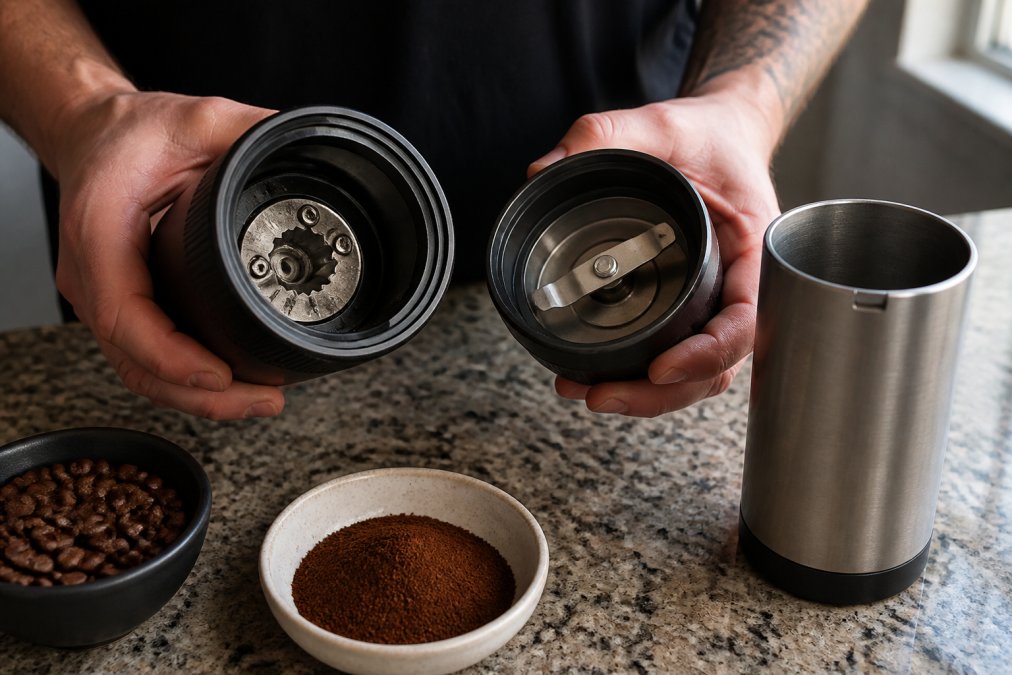
Crushing Mechanism vs. Chopping Mechanism
The crushing mechanism in a burr grinder feeds beans between two burrs and grinds them to a set gap, so every particle leaves at roughly the same size.
The chopping mechanism in a blade grinder works like a food processor: steel blades spin fast and shatter beans into a mix of dust and chunks. You cannot set a target size, only a run time.
Grind Consistency and Particle Size Distribution
Grind consistency is the measure of how uniform your coffee particles are after grinding. Burr grinders produce a narrow particle size distribution, with most grounds in a tight size range. Blade grinders produce a wide spread: fine powder, medium grit, and coarse fragments in the same batch. This matters because water extracts flavor at different rates depending on particle size.
- Fine particles extract fast, releasing bitterness and harsh notes
- Coarse particles extract slowly, leaving sourness and weak flavor
- Uniform particles extract evenly, giving you a balanced cup
A blade grinder guarantees you get all three problems at once. A burr grinder gives you one consistent result you can adjust and repeat.
How Grind Quality Changes Extraction and Flavor
Extraction yield is the percentage of coffee solids dissolved into your water. When your grind is uneven, some grounds over-extract while others under-extract, producing a cup that tastes bitter and sour at once, a problem no brewing adjustment can fix. Blaming the beans or the brewer is a common mistake; in practice, the grinder is usually the culprit.
Here's what changes when you switch to a burr grinder:
- Bitterness drops because fine dust stops over-extracting
- Acidity becomes cleaner because coarse chunks stop under-extracting
- Flavor notes from the bean actually show up in the cup
- You can dial in a recipe and repeat it tomorrow
For anyone chasing tasting notes on a single-origin bean, this is the difference between reading the label and tasting it.
Coffee Grind Size Chart: Matching Grind to Your Brewing Method
The right grind size depends on your brewing method and contact time. Below is a practical coffee grind size chart for common home setups.
| Brewing Method | Grind Size | Texture | Typical Brew Time |
|---|---|---|---|
| French press | Coarse | Sea salt | 4 minutes |
| Drip coffee | Medium | Table salt | 4-6 minutes |
| Pour-over | Medium-fine | Fine sand | 2-4 minutes |
| Espresso | Fine | Powdered sugar | 25-30 seconds |
| Moka pot | Fine-medium | Fine sand | 3-5 minutes |
A burr grinder lets you move between these settings with micro-adjustments. A blade grinder cannot hit any of them on purpose.
Conical vs Flat Burr Grinders: Which Design Fits Your Counter
The conical vs flat burr grinders debate comes down to burr geometry, rotational speed, and how grounds exit the chamber. Those variables drive every practical difference at home: noise, heat, retention, and particle distribution.
Conical burr grinders use a cone-shaped inner burr nested inside a ring burr. Beans fall between the surfaces and are crushed as the cone rotates, typically at a few hundred to roughly 1,000 RPM. The angled burrs let gravity pull grounds down and out, which means lower retention, fewer old grounds sitting in the chamber between sessions. The geometry also produces a slightly wider spread of fines and boulders than flat burrs, which many brewers find forgiving for drip, pour-over, and French press.
Flat burr grinders use two parallel discs, one stationary and one rotating, shearing beans between the flat faces as they travel outward from the center. They often run at higher RPM than conical models, which means more heat into the grounds and more noise.
| Feature | Conical Burrs | Flat Burrs |
|---|---|---|
| Burr shape | Cone inside ring | Two parallel discs |
| Typical RPM | Lower (often a few hundred to ~1,000) | Higher (often 1,000+ depending on model) |
| Noise level | Quieter | Louder |
| Heat buildup | Lower | Higher |
| Retention | Lower | Higher |
| Particle distribution | Wider spread, forgiving | Tighter, more bimodal |
| Best for | Drip, pour-over, French press, first upgrade | Espresso, precision brewing |
Noise, Static, and Mess: What Reviews Rarely Mention
- RPM rating, lower is generally quieter. Conical models often list a few hundred RPM; flat models often list 1,000 RPM or more.
- Motor type, gear-reduced motors trade speed for torque and tend to run quieter than direct-drive high-speed motors.
- Burr size, larger burrs grind the same dose in less time, so the noise window is shorter even if the peak volume is similar.
- Housing and feet, rubber feet and a heavier base reduce vibration, which is a big part of perceived loudness.
Practical countermeasures that work on any grinder:
- Add a few drops of water to the beans before grinding. A common ratio is one or two drops per dose, tossed to coat the beans. This is sometimes called the RDT (Ross Droplet Technique) in coffee communities, and it reliably cuts static on both blade and burr grinders.
- Grind into a metal container rather than plastic when possible. Metal dissipates charge faster than plastic.
- Let the grinder rest a few seconds after the motor stops before opening the lid, so airborne fines settle.
- Wipe the chute and lid with a dry cloth between sessions to remove clinging dust before it builds up.
- Store beans in a low-humidity spot. Static gets worse as ambient humidity drops.
Best Coffee Beans for Home Espresso (and Why the Grinder Comes First)
Even the best coffee beans for home espresso will taste flat if your grind is uneven. Espresso is the least forgiving brewing method because it pushes water through a small puck in about 25 to 30 seconds. Any inconsistency in particle size creates channeling, where water finds the path of least resistance and skips most of the coffee.
- Look for a roast date, not just a best-by date
- Match the roast to your taste: darker for chocolate and caramel, lighter for fruit and acidity
- Store beans whole and grind right before brewing
- Buy in smaller amounts so you finish the bag while it is still fresh
Specialty Coffee Association brewing standards
Frequently Asked Questions
Do burr grinders really make a difference in coffee flavor?
Yes, and the difference comes down to particle uniformity. A burr grinder crushes beans to a consistent size, so hot water extracts flavor evenly across every particle. A blade grinder chops beans into a mix of fine dust and coarse chunks, which means some grounds over-extract into bitterness while others under-extract and taste sour. In side-by-side blind testing, most home brewers notice the improvement first in espresso and pour-over, where grind consistency has the largest effect on extraction yield.
Can a blade grinder produce a consistent grind size?
Not reliably. Blade grinders use a spinning blade that chops whatever happens to be in its path, so the result depends on how long you pulse and how the beans tumble. You can shake the grinder mid-pulse or sift the grounds to improve uniformity, but you will still get a wide particle size distribution. For French press, where coarse grounds are forgiving, that is workable. For espresso or drip coffee, a blade grinder makes repeatable results nearly impossible.
Which type of burr grinder is better, ceramic or stainless steel?
Ceramic burrs stay cooler during grinding and resist corrosion, but they can chip if a stray stone or hard object passes through. Stainless steel burrs hold a sharp edge longer, cut through beans with less motor strain, and are the standard choice for espresso-focused grinders. For most home setups, stainless steel flat or conical burrs offer the better balance of durability and grind quality. Whichever you pick, clean the burrs regularly and replace them once grind times stretch or flavor turns flat.
What type of coffee grinder is best for home espresso?
Espresso demands the finest, most uniform grind of any brewing method, so a burr grinder with micro-adjustments is the practical choice. Look for stepless or fine-stepped settings so you can dial in a 25 to 30 second shot, plus enough motor torque to grind light roasts without stalling. Pair it with fresh beans roasted for espresso, ideally within two to four weeks of the roast date, and adjust the grind as the beans age. A blade grinder cannot hold the consistency espresso requires.