

How to Find Your Favorite Breakfast Blend Coffee
Last Updated: November 8, 2026
Quick Summary
To find your favorite breakfast blend coffee, read the roast level and origin on the bag before trusting the name, since breakfast blend is a marketing term, not a regulated category. Then taste two or three coffees side by side in one session and score each on sweetness, acidity, body and finish. Map your highest scores back to roast level and origin rather than to a brand name.
- Breakfast blend coffee is a medium-roast blend built for a smooth, easy morning cup.
- Scan bags in order: roast level, origin, process, roast date, then flavor notes.
- Taste three coffees with different roast levels or origins, moving from lightest to darkest.
- Rate each cup 1 to 5 on sweetness, acidity, body and finish to spot your pattern.
- Buy whole bean and grind just before brewing to keep the aroma.
Table of Contents
- Start With What Breakfast Blend Coffee Actually Means
- Breakfast Blend Coffee Flavor: What to Expect in the Cup
- Breakfast Blend Coffee Roast Level and How It Changes Taste
- A Repeatable Taste-Testing Method to Find Your Match
- Best Breakfast Blend Coffee Beans for Whole Bean and Ground Drinkers
- Best Breakfast Blend Coffee K-Cups and Single-Serve Options
- How Brewing Variables Affect the Same Blend
- Freshness, Storage, and Buying Quantities That Protect Flavor
- Frequently Asked Questions
Start With What Breakfast Blend Coffee Actually Means
Breakfast blend coffee is a medium-roast blend built for a smooth, easy cup first thing in the morning. It is a marketing name, not a regulated category. That matters: two bags labeled "breakfast blend" can taste completely different. Most people assume "breakfast" means light and weak. The opposite is closer to the truth.
Marketing Labels vs. Standardized Roast Categories
Roast levels are the only part of the label with real meaning. Light, medium, medium-dark and dark describe how long beans stay in the roaster.
"Breakfast blend" describes nothing official. It signals a morning-friendly cup: smooth, balanced, low on harsh edges. A roaster can put almost any bean combination behind that name.
So read the roast level first. Then read the origin. The name on the front tells you the least.
How to Decode a Bag in 30 Seconds
When you pick up a bag, scan it in this order:
- Roast level: Look for light, medium, medium-dark or dark. If the bag only says "breakfast blend" with no roast level, treat that as a warning sign.
- Origin or region: Single origins like Colombia or Ethiopia tell you more than a vague "South American blend." Blends are fine, but the bag should name the regions.
- Process: Washed, natural or honey processing changes flavor significantly. Washed coffees tend to be cleaner and more predictable; natural coffees tend to be fruitier and more variable.
- Roast date: A "best by" date is not the same as a roast date. Freshness matters more than almost any other label claim.
- Flavor notes: Treat these as clues, not promises. "Cocoa and caramel" usually means a medium roast with Brazilian or Colombian beans; "citrus and floral" usually means a light roast with East African beans.
What the Label Does Not Tell You
A few things are almost never on the bag but matter just as much:
- Caffeine content: Roast level does not reliably indicate caffeine. A dark roast is not automatically stronger than a light roast; caffeine varies more by bean and dose than by roast.
- Acidity: "Smooth" on a bag does not mean low-acid. If you are sensitive to acidity, look for medium-dark or dark roasts and origins known for lower acidity, such as Sumatra.
- Brew method: A coffee marketed for drip may taste thin in a French press. The bag rarely tells you how the roaster intended it to be brewed.
A common pattern is that bags with the most specific information, roast date, origin, process and roast level, are the ones worth comparing first. Bags with only a slogan give you nothing to compare.
Watch out: a bag labeled "breakfast blend" with no roast level and no origin is a marketing product first and a coffee second; you cannot predict how it will taste.
Breakfast Blend Coffee Flavor: What to Expect in the Cup
Most breakfast blends land in the mild, sweet zone. Expect low bitterness, a round body and a clean finish.
Flavor comes from origin as much as roast. South American beans, especially from Colombia, Peru and Brazil, bring cocoa, caramel and soft citrus notes.
A good breakfast blend tastes like something you can drink black without wincing. Add milk and it holds up without going flat.
Breakfast Blend Coffee Roast Level and How It Changes Taste
Roast level is the biggest lever you control before brewing. A medium roast keeps sweetness and aroma intact. Push darker and you trade fruit and caramel for smoke and bite.
Here is how the scale plays out in a morning cup:
- Light roast: bright, tangy, more acidity, lighter body
- Medium roast: balanced, sweet, smooth, the classic breakfast profile
- Medium-dark roast: deeper body, cocoa and caramel, less brightness
- Dark roast: bold, smoky, low acidity, heavier finish
If you want the full breakdown before you commit, read our guide on light roast vs medium roast coffee taste. It walks through how each level changes the cup.
A Repeatable Taste-Testing Method to Find Your Match
Guessing wastes money. Taste two or three coffees side by side, in the same session, and your preference becomes obvious fast. The goal is not to become a coffee judge.
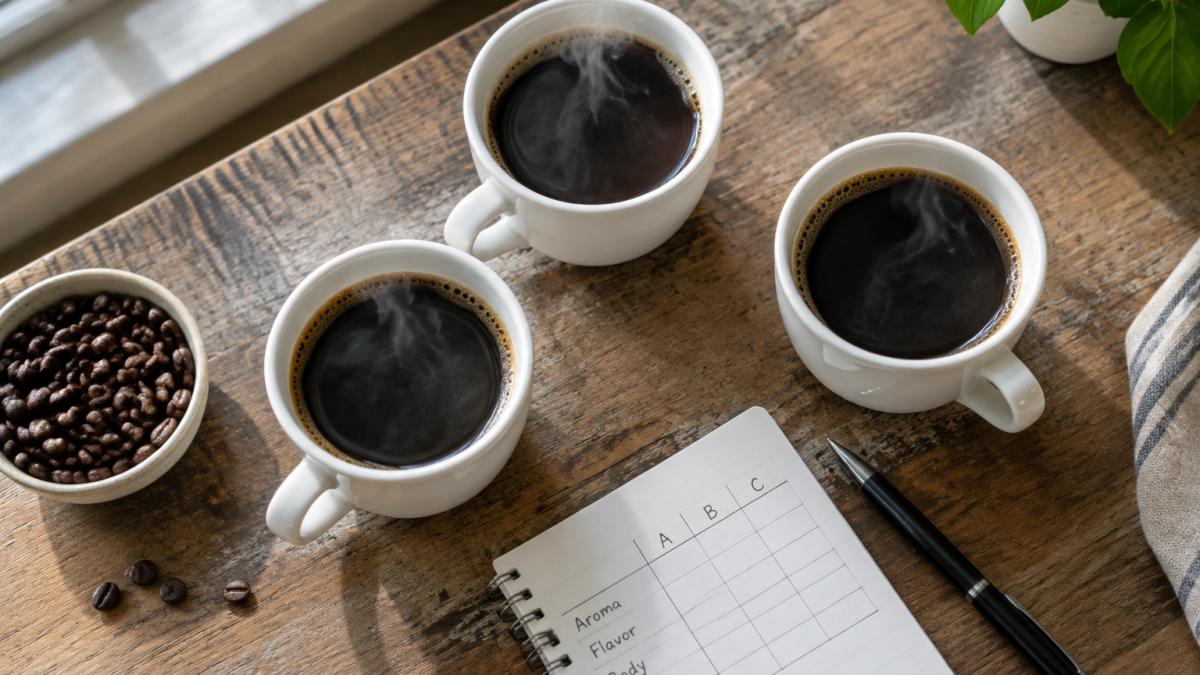
Set Up a Side-by-Side Tasting at Home
- Pick three coffees with different roast levels or origins. A light, a medium and a medium-dark give you the widest spread without overwhelming your palate.
- Grind each one the same way, right before brewing. If you buy pre-ground, use the same grind across all three.
- Use the same brewer, the same water and the same dose for all three. Weigh if you can: about 1 ounce of coffee per 16 ounces of water is a reasonable starting ratio.
- Taste them warm, not hot. Let each cup cool for a minute so the aromatics settle and you can actually taste sweetness instead of just heat.
- Slurp a small amount from each cup, moving from lightest roast to darkest so your palate is not overwhelmed early.
- Write one word per cup for each of four categories: sweetness, acidity, body and finish.
- Note which one you would happily drink black, and which one improved most with milk.
Score Each Cup on Four Axes
A simple scorecard keeps the comparison honest. Rate each coffee from 1 to 5 on these four axes, then look for the pattern:
- Sweetness: Does the cup taste like caramel, cocoa or fruit, or does it taste flat and ashy?
- Acidity: Does it feel bright and lively, or dull and heavy? Neither is wrong; you are measuring preference, not quality.
- Body: Does it feel thin like tea, or round and coating like whole milk?
- Finish: Does the flavor fade cleanly, or leave a dry, bitter or smoky aftertaste?
Most people find that the coffee they rate highest on sweetness and finish is the one they reach for again. If you rate two cups identically, the tiebreaker is which one you would want a second cup of.
Translate the Results Into a Buying Decision
Once you have scores, map them to roast and origin rather than to a brand name:
- High sweetness plus low acidity usually points to a medium or medium-dark roast with Brazilian or Colombian beans.
- High acidity plus light body usually points to a light roast with East African beans.
- High body plus low acidity usually points to a medium-dark or dark roast, often with beans from Sumatra or the Americas.
A sample pack makes this easy. Our best sellers sample pack includes Breakfast Blend alongside five other roasts, so you can run the test in one sitting and compare across the full range.

Watch out: tasting more than three cups in one session dulls your palate, so keep the lineup small and take a sip of water between cups.
Here is the side-by-side tasting method boiled down to its steps.
| Step | What to do |
|---|---|
| 1 | Pick three coffees with different roast levels or origins |
| 2 | Grind each the same way, right before brewing |
| 3 | Use the same brewer, water and dose for all three |
| 4 | Taste them warm, not hot |
| 5 | Slurp from lightest roast to darkest |
| 6 | Write one word per cup for four categories |
| 7 | Note which you would drink black and with milk |
Best Breakfast Blend Coffee Beans for Whole Bean and Ground Drinkers
Whole bean wins on freshness, no contest. Grind just before brewing and you keep the aroma that makes a morning cup worth getting up for.
Our pick is the Breakfast Blend, a medium roast with a smooth blend of South American coffees.

A common mistake is buying a dark roast because it sounds stronger. Stronger is not better at 7 a.m. Smooth wins.
Best Breakfast Blend Coffee K-Cups and Single-Serve Options
Single-serve pods trade a little flavor for a lot of speed. For busy mornings, that is a fair deal. Look for pods that name the roast level and the origin, not just a flavor slogan.
Our 12 pack single serve coffee capsules let you try the breakfast blend without committing to a full bag. Keep a box for travel weeks and early meetings. Use whole bean on slower mornings when you have five extra minutes.

How Brewing Variables Affect the Same Blend
The same bag can taste sweet or bitter depending on how you brew it. Three variables do most of the damage.
- Grind size: too fine and the cup turns bitter; too coarse and it tastes weak and sour
- Coffee-to-water ratio: start around one scoop per cup and adjust from there
- Water temperature: just off the boil, never boiling, for drip and pour-over
Drip makers favor medium roasts. A French press brings out body and a rounder finish. A pour-over highlights brightness and aroma. Change one variable at a time so you know what actually helped.
Freshness, Storage, and Buying Quantities That Protect Flavor
Coffee peaks days after roasting and fades from there. Oxygen, light, heat and moisture are the enemies. Store beans in an airtight container, in a dark cupboard, at room temperature.
Skip the freezer for daily-use bags. Condensation does more harm than the cold does good.
Buy in quantities you will finish in a few weeks. Our guide to why fresh roasted coffee tastes better explains what happens to beans as they age and how to spot stale coffee before you brew it.
Finding your favorite breakfast blend comes down to three moves: know the roast level, taste side by side, and buy fresh in small batches. theITDGroup LLC roasts to order so every bag reaches you close to peak flavor, with a fresh roast guarantee, carefully sourced beans and reliable delivery to your door. Start with our medium-roast Breakfast Blend, or run the sample pack test and let your own palate decide. Get started with theITDGroup LLC and find the roast you reach for every morning.
Frequently Asked Questions
What roast level is breakfast blend coffee?
Most breakfast blend coffee is a medium or light-medium roast, designed to be smooth and easy to drink in the morning. A medium roast keeps some brightness and sweetness while rounding off acidity. Some brands add robusta for extra caffeine, which shifts the body and finish. Check the label: if it says medium, expect a balanced cup with mild sweetness; if light, expect more acidity and a brighter finish.
Is breakfast blend coffee stronger than regular coffee?
Usually not. Breakfast blends are typically medium roasts with moderate caffeine, similar to a standard medium roast. Strength depends on your coffee-to-water ratio and grind size more than the blend name. A breakfast blend plus robusta, however, does deliver extra caffeine. If you want a stronger cup, use more grounds per ounce of water rather than assuming the label means higher caffeine.
How do I choose a breakfast blend coffee that fits my taste?
Start by identifying whether you prefer smooth and mild or bold and roasty. Medium roasts with South American beans tend to be smooth with caramel or citrus notes. If you like a heavier cup, look for a medium-dark or dark breakfast blend. Buy a sample pack of two-ounce bags and taste them side by side using the same brewing method so the only variable is the coffee itself.
Which brewing method works best for breakfast blend coffee?
Drip and pour-over highlight the clean, balanced flavors most breakfast blends are built for. A French press adds body and oils, which suits medium-dark versions. Whichever method you pick, keep your grind size matched to it and use about two tablespoons of coffee per six ounces of water as a starting ratio.
