

How Much Coffee Beans to Buy at Once: A Buying Guide
Last Updated: November 11, 2026
Quick Summary
Buy enough coffee beans to last about two to four weeks, since beans taste freshest in that window after roasting. For one daily drinker, a 12-ounce bag covers roughly 15 to 35 days, while a 1-pound bag suits most solo drinkers. Calculate by counting daily cups, choosing a reorder interval, and multiplying by your grams per cup.
- A 12-ounce bag yields roughly 30 to 40 cups depending on brew strength.
- A common home starting dose is about 10 grams of ground coffee per 6-ounce cup.
- Divide your total grams needed by 454 to convert to pounds.
- Add a 10 to 15 percent buffer for guests and stronger brews.
- Store opened beans in an airtight container in a cool, dark place.
Table of Contents
- How Much Coffee Beans Should You Buy at Once?
- How Many Cups Does Each Bag Yield?
- Standard Coffee-to-Water Ratios and Cup Sizes
- Calculating Your Household's Buy-at-Once Amount
- How Long 1 Pound of Coffee Beans Lasts
- Coffee Bean Storage Best Practices
- Choosing Your Next Bag Size and Roast Date
- Frequently Asked Questions
How Much Coffee Beans Should You Buy at Once?
Buying coffee beans in the right amount keeps your cups tasting fresh and your wallet happy. Coffee roasted to order arrives ready to brew. The best quantity to buy at once depends on how many cups you drink, how fast you go through beans, and how much storage space you have.
For most home drinkers, a single 12-ounce bag covers a few weeks. Buy too little and you reorder constantly. Buy too much and the beans lose their aroma before you finish them. This guide walks through the math, the storage habits, and the freshness tradeoffs so you can pick a bag size with confidence.
Our Best Sellers Sample Pack: 6Bean, Cowboy, Breakfast, Peru, Mexico, Bali at $24.99 lets you sample several of our best-selling coffees in 2 oz packs before you commit to a full bag.
How Many Cups Does Each Bag Yield?
A typical 12-ounce bag of whole coffee beans yields roughly 30 to 40 cups, depending on how strong you brew. Most home recipes use about 2 tablespoons of ground coffee for a 6-ounce cup, which works out to about 10 grams per cup.
| Bag Size | Approximate Cups | Cups per Day (1 drinker) | Days Covered |
|---|---|---|---|
| 12 oz | 30 to 40 | 1 to 2 | 15 to 35 |
| 1 lb (16 oz) | 40 to 55 | 1 to 2 | 20 to 45 |
| 2 lb | 80 to 110 | 2 to 3 | 30 to 50 |
These numbers are estimates. Stronger coffee uses more beans per cup, so your bag may go faster.
Standard Coffee-to-Water Ratios and Cup Sizes
The common brew ratio is about 1 gram of coffee for every 15 to 17 grams of water. Many people find this a good balance of strength and flavor.
- Standard cup: about 6 ounces (roughly 180 ml)
- Mug: about 12 ounces
- Light brew: use less coffee per cup
- Strong brew: add more coffee, or brew less water
Weigh your beans with a kitchen scale if you want consistent results. Measuring by scoop can vary a lot from one bag to the next.
Calculating Your Household's Buy-at-Once Amount
Most people overbuy or underbuy because they estimate by feel instead of by counting. A simple calculation takes about a minute and removes most of the guesswork.
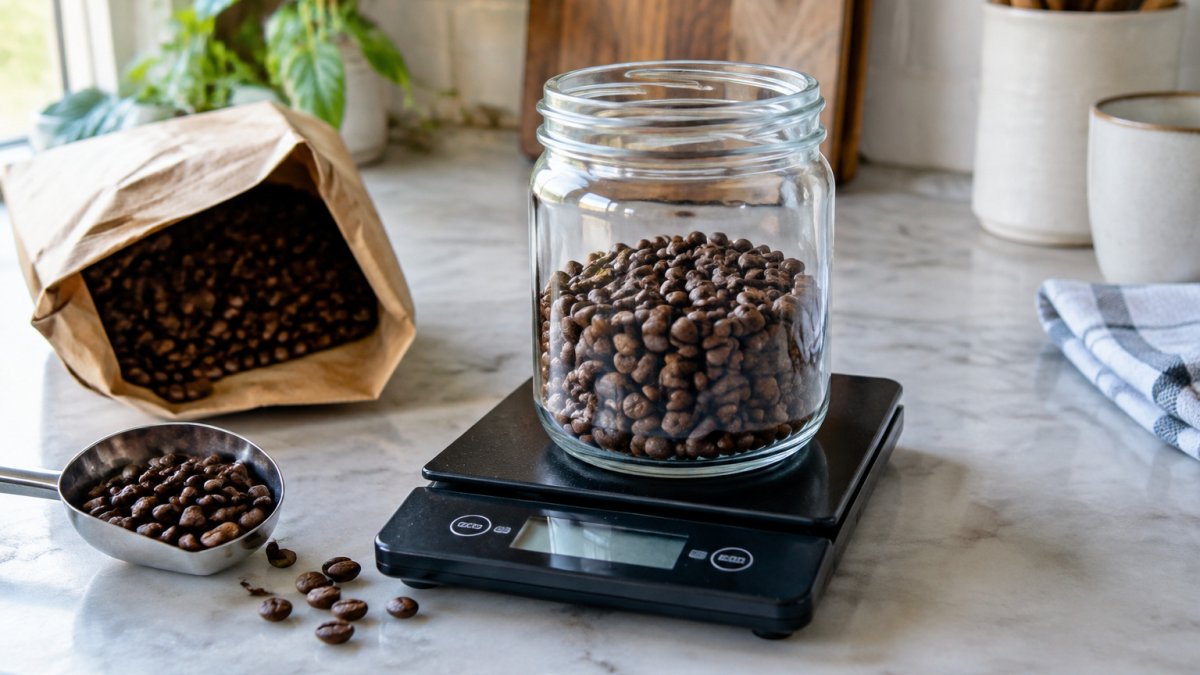
Step 1: Count your cups per day. Include every cup, not just the morning one. Count each drinker separately, and note whether cups are full-size or small (a 6-ounce cup and a 12-ounce mug use very different amounts of coffee).
Step 2: Pick a reorder interval. Choose how many days you want one bag to last. Two to four weeks is a comfortable window for most households, because it keeps beans inside the period when they still taste fresh.
Step 3: Apply a dose. A common home starting point is about 10 grams of ground coffee per 6-ounce cup, or about 18 grams per 12-ounce mug at a stronger brew. Adjust this number after a few test cups, since beans and roasts vary.
Step 4: Multiply and convert.
- Total cups per day × interval in days × grams per cup = grams needed
- Divide grams by 454 to get pounds (there are 454 grams in one pound)
Worked examples:
- One drinker, two 6-ounce cups a day, ordering every 4 weeks: 2 × 28 × 10 = 560 grams, about 1.2 pounds. A 1-pound bag plus a small buffer fits well.
- Two drinkers, two 12-ounce mugs each per day, ordering every 4 weeks: 4 × 28 × 18 = 2,016 grams, about 4.4 pounds. Here a 2-pound bag ordered twice a month, or a 5-pound order, is more practical.
- Occasional drinker, about 3 cups a week, ordering every 8 weeks: 3 × 56 × 10 = 1,680 grams total, about 3.7 pounds. Because beans will go stale before this is finished, buying two or three smaller bags spaced out is usually the better choice.
Adding a buffer. A 10 to 15 percent margin covers days with guests, weekend brewing, or a stronger cup than usual. Going much higher than that tends to create stale leftovers rather than savings.
Adjust for brew method. Espresso uses a much higher dose per shot than drip or French press, so an espresso household will go through beans faster even with fewer cups. Recalculate with the dose for your actual method instead of reusing a drip-coffee number.
Watch out: If you change brew strength in the middle of a bag, your estimate changes too. Recheck the formula whenever your routine shifts.
How Long 1 Pound of Coffee Beans Lasts
One pound of beans lasts about 3 to 4 weeks for one daily drinker. Two drinkers who share a pot often finish it in under two weeks.
Freshness matters more than the calendar. Beans taste best in the first few weeks after roasting. After that, the aromatic oils fade, and the cup gets flat. This is why buying a size you can finish quickly usually tastes better than buying in bulk.
Coffee Bean Storage Best Practices
Storage determines how long your purchase stays good, so it belongs in the buying decision, not just after it. The right approach depends on whether the bag is still sealed.
Unopened bags. A sealed bag with a one-way degassing valve protects beans well for several weeks from the roast date. Keep it in a cool, dark cupboard away from the stove, dishwasher, and sunny windows. Heat and light break down aromatic oils faster than air alone does.
Opened bags. Once opened, oxygen becomes the main enemy. Two practical options:
- Transfer beans to an airtight container with as little headspace as possible, and keep it in the same cool, dark spot.
- Keep the original bag, press out air, fold the top tightly, and clip or tape it closed.
Fridge and freezer. Refrigeration is a poor choice for most people because condensation forms each time the container is opened. Freezing can work for a large bag you will not finish within about four weeks. Portion it into several sealed bags, freeze all of them, and thaw only one portion at a time. Do not refreeze thawed beans, and let a portion come to room temperature inside its sealed bag before opening it, so moisture does not condense on the beans.
Grind just before brewing. Ground coffee loses flavor far faster than whole beans, so grinding only what you need is one of the most effective storage habits.
Connecting storage to purchase size. If your storage habits can keep a bag tasting good for about three to four weeks after opening, buy in quantities you can finish inside that window. A larger bag saves money per cup only if you use it before the flavor fades.
Watch out: Repeatedly opening a frozen bag and returning it to the freezer lets moisture in, which speeds staling even when the beans are kept cold.
Choosing Your Next Bag Size and Roast Date
When you order, check the roast date and pick the size you can finish soon after. If you are new to a blend, start small. Our Single Origin Favorites Sample Pack at $24.99 lets you taste several origins before you buy a full bag.
Once you know your usual pace, move up to a larger bag to save on per-cup cost. Set a reorder reminder so you never run out in the middle of the week.
Finding the right amount of coffee beans is about matching your pace to freshness. Start with the math, store your beans well, and buy in sizes you can enjoy while they are at their best. Explore our roasts and find your perfect roast today.
Frequently Asked Questions
What is the 15-15-15 coffee rule?
The 15-15-15 rule is a brewing guideline: about 15 grams of coffee, 15 ounces of water and a 15-minute window from grind to brew, though many brewers use it loosely as a starting point. For buying purposes, it helps you estimate usage: 15 grams is roughly two tablespoons of ground coffee per cup. Weigh your beans before grinding for consistent results. Adjust the ratio to taste, since stronger or weaker coffee changes how fast a bag runs out.
How long does 1 lb of coffee beans last?
A pound of whole beans typically lasts about two to four weeks for a daily drinker making one or two cups a day, depending on cup size and dose. Once opened, beans begin losing aroma within days to weeks, so a pound used by one person may stay at peak flavor for only part of that time. Buying smaller amounts more often keeps the coffee fresher, while larger bags make sense for households that drink coffee every day.
How many cups of coffee can you make with a 12 oz bag of beans?
A 12-ounce bag holds about 340 grams of beans. At roughly 15 grams per six-ounce cup, that yields around 22 to 23 cups. Using a stronger dose of 20 grams per cup drops the yield to about 17 cups. Larger cup sizes or a weaker brew stretch the bag further. Count your typical dose and cup size to estimate how many days a bag will last in your household.
How long does 1 lb of coffee beans stay fresh after opening?
After opening, a pound of beans stays at its best for roughly one to two weeks for flavor, and can remain drinkable for several weeks beyond that. Keeping the bag sealed, away from heat, light and moisture, slows staling. If you know a bag will take longer than a month to finish, consider dividing it and storing portions separately so only one part is exposed to air at a time.
