

Blue Bottle Alternative for Coffee Lovers: Top Picks
Table of Contents
- What Coffee Lovers Actually Want in a Blue Bottle Alternative
- Coffee Brands Similar to Blue Bottle: What to Compare
- Freshly Roasted Coffee Subscription: Why Roast Date Beats Brand Name
- Coffee Subscription Services: Pricing Breakdown and Cost Per Cup
- How to Choose a Coffee Subscription Service That Fits Your Brew Method
- The Shortlist: Best Blue Bottle Alternative by Coffee Preference
- Conclusion: Finding Your Perfect Roast
- Frequently Asked Questions
Last Updated: October 5, 2026
What Coffee Lovers Actually Want in a Blue Bottle Alternative
When regulars start hunting for a blue bottle alternative for coffee lovers, they usually aren't chasing a brand name. They want the same thing Blue Bottle built its reputation on: beans with a roast date stamped on the bag, a flavor profile that matches the description, and a café-level cup brewed at home. At theITDGroup LLC, we roast every batch to order, which is why freshness sits at the center of how we think about specialty coffee.
Here's the part most guides get wrong: freshness and price matter more than the logo on the bag.
The three questions below decide almost every switch.
Taste, Freshness, and Price: The Three-Decision Framework
Every blue bottle alternative decision comes down to three trade-offs:
- Taste: Does the tasting notes description match what lands in your cup?
- Freshness: Is there a printed roast date, or just a vague "best by" stamp?
- Price: What does each cup actually cost, including shipping?
A coffee roaster that prints a real roast date wins on freshness. A coffee blend or single-origin that lists origin and process wins on trust. And a subscription that fits your brew method wins on value.
Get those three right and brand loyalty follows.
Coffee Brands Similar to Blue Bottle: What to Compare
Coffee brands similar to Blue Bottle share a few traits: transparent sourcing, small-batch roasting, and clear tasting notes. What separates them is how specific that information gets.
Compare on four things:
- Roast level (light, medium, or dark)
- Origin and process (washed, natural, or blend)
- Roast date on the bag
- Grind options matched to your brew method
A roaster that publishes all four is telling you exactly what you're buying. One that hides behind "artisan" language usually isn't.
Roast Profiles and Flavor Notes Side by Side
Roast profiles change everything about the cup. A light roast keeps acidity and fruit; a medium roast balances body and sweetness; a dark roast pushes bold, smoky flavor.
| Roast Level | Typical Flavor Notes | Best Brew Method | Acidity |
|---|---|---|---|
| Light | Floral, citrus, berry | Pour-over, drip | High |
| Medium | Cocoa, caramel, nutty | Drip, espresso | Medium |
| Medium-dark | Caramel, spice, brown sugar | Espresso, cold brew | Lower |
| Dark | Bold, smoky, bittersweet | Espresso, French press | Low |
If you like smooth and bold, go medium to medium-dark. If you want bright acidity and floral notes, stay light.
Freshly Roasted Coffee Subscription: Why Roast Date Beats Brand Name
A freshly roasted coffee subscription solves the one problem no brand name can: time. Coffee starts losing aroma within days of roasting, so a bag roasted last week beats a premium label roasted two months ago.
That's why we print a roast date, not a "best by" date. It tells you exactly how fresh the coffee beans are.
When you compare coffee subscription services, treat the roast date as your first filter. Everything else is secondary.
Coffee Subscription Services: Pricing Breakdown and Cost Per Cup
Price is the most-cited reason people switch roasters, yet almost no alternatives guide shows a standardized cost comparison. This section does. The goal is not to name the cheapest bag, it's to show what each cup actually costs once shipping, subscription discounts, and bag size are accounted for.
The Three Numbers That Decide Value
- Bag price, the sticker price before shipping.
- Delivered price, bag price plus shipping, minus any subscription discount.
- Cost per cup, delivered price divided by the number of cups the bag yields.
Most coffee subscription services price between roughly $18 and $30 per 12-ounce bag. Our own coffee delivery starts at $23.99 per bag. At about 16 cups per 12-ounce bag, a $23.99 bag works out to roughly $1.50 per cup before any shipping or discount.
| Purchase Type | Bag Price | Typical Shipping | Delivered Price | Cost Per Cup (16 cups) |
|---|---|---|---|---|
| One-time bag | $23.99 | Varies by carrier | $23.99 + shipping | ~$1.50 + shipping share |
| Recurring subscription | $23.99 | Often reduced or free at threshold | Lower effective rate | Below $1.50 |
| Sample pack (6 × 2 oz) | $24.99 | Varies | $24.99 + shipping | Varies by brew |
Treat the table as a framework, not a quote. Shipping rates change by carrier and order size, and subscription terms vary by roaster. The habit that matters is running the same three-number calculation on every option you consider.

Why Cost Per Cup Beats Cost Per Bag
A $16 bag sounds cheaper than a $24 bag until you do the math. If the $16 bag is three weeks old, you may brew it twice and pour the rest out, a $16 bag that yields four good cups costs $4.00 per good cup. A $24 bag roasted this week that yields sixteen good cups costs $1.50 per good cup. The cheaper bag lost.
This is why roast date and cost per cup belong in the same calculation. Freshness determines how many cups you actually drink; price determines what each one costs.
One-Time Bags vs. Recurring Delivery
- One-time bags: Best if you drink slowly, want to sample first, or brew fewer than a few cups a week. You pay full shipping but keep full flexibility.
- Recurring delivery: Best for daily drinkers who want a fixed schedule and consistent fresh-roasted supply. Subscriptions usually reduce per-bag cost and often waive shipping above a threshold.
- Sample packs: Best for finding your flavor profile before committing. A six-pack of 2-ounce bags lets you taste across origins for roughly the price of one full bag.
A Simple Break-Even Check
Before you subscribe, estimate your weekly cup count. If you drink two cups a day, a 12-ounce bag lasts about eight days, so a weekly or biweekly delivery keeps you in fresh coffee without stockpiling. If you drink two cups a week, a one-time bag every two months beats a subscription you can't consume in time.
How to Choose a Coffee Subscription Service That Fits Your Brew Method
Matching a coffee subscription service to your brew method prevents the most common mistake: buying whole bean when you need ground coffee, or the wrong grind size for your gear.
- Espresso: Fine grind, medium to medium-dark roast
- Pour-over: Medium grind, light to medium roast
- Drip coffee: Medium grind, any roast
- Cold brew: Coarse grind, medium to dark roast
The Shortlist: Best Blue Bottle Alternative by Coffee Preference
The best blue bottle alternative depends on how you drink coffee, not on which brand has the loudest marketing. Below is our shortlist, matched to flavor profile and brew method.
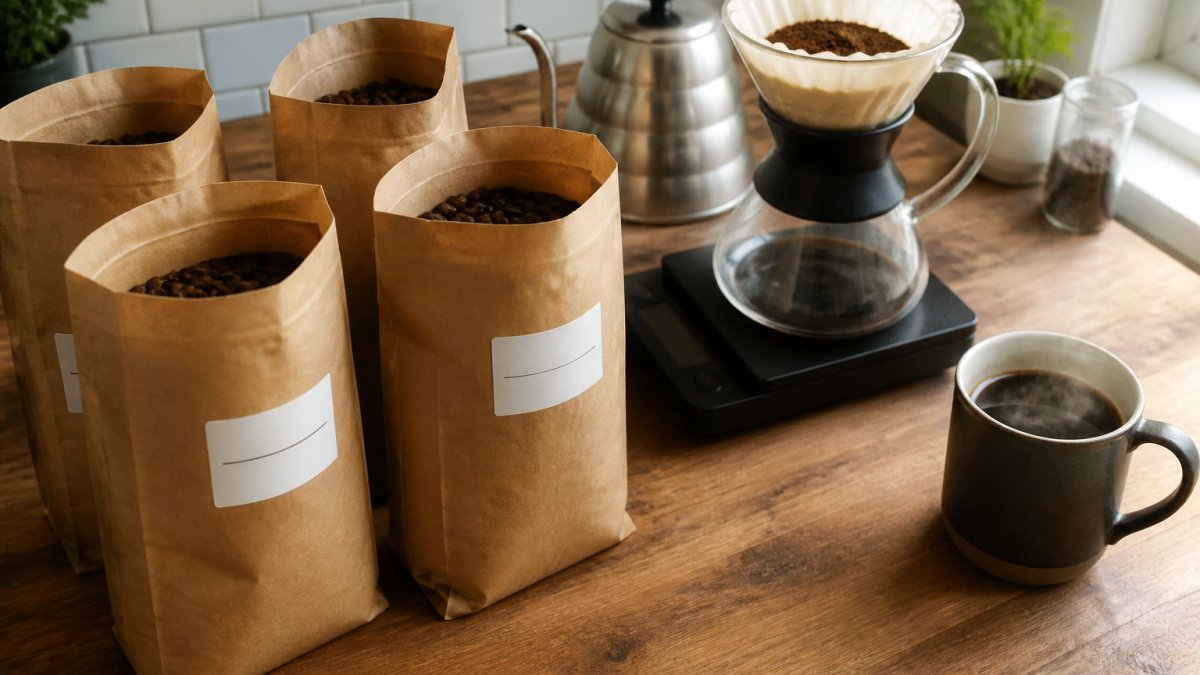
Every option below is roasted to order, sold as whole bean or ground, and priced at $23.99 per bag, except the sample pack at $24.99.
For Espresso Drinkers: Blonde and House Blend
Blonde is our top pick for espresso. It's a sweet blend from Central America and Africa built for a sweet espresso shot, with a clean, smooth finish.
House Blend is the everyday workhorse: a medium roast blend from Central and South America with nutty, sweet chocolate, and mild citrus notes. It pulls a balanced shot and holds up in drip coffee too.
| Product | Roast | Tasting Notes | Best For | Price |
|---|---|---|---|---|
| Blonde | Light-medium | Sweet, clean | Sweet espresso | $23.99 |
| House Blend | Medium | Nutty, chocolate, citrus | Espresso, drip | $23.99 |
| Cold Brew Coffee | Medium | Chocolate, toffee, floral | Cold brew, nitro | $23.99 |
For Single-Origin Explorers: Ethiopia Natural, Kenya, and the Sample Pack
Ethiopia Natural is a med-light single-origin from smallholder farmers in the Sidama zone, with milk chocolate, fruity, and caramel notes. It's organic-minded sourcing at its most traceable.
Kenya brings bright acidity with orange, lemon, and floral notes, fully washed and dried on raised beds in Nyeri County.
If you can't decide, the Single Origin Favorites Sample Pack gives you six 2-ounce packs, including Brazil Santos, Colombia, Costa Rica, Ethiopia, Honduras, and Tanzania, for $24.99. It's the fastest way to find your flavor profile before committing to a full bag.
Conclusion: Finding Your Perfect Roast
Switching roasters is a gamble when you can't taste first. The fix is simple: start with a sample pack, check the roast date, and match your grind size to your brew method.
At theITDGroup LLC, we roast to order, print a real fresh roast guarantee, and ship whole bean or ground so your first cup tastes like the last. Our carefully sourced beans and roasted-to-order process are built for exactly that.
Find your perfect roast with theITDGroup LLC and taste the difference a fresh roast date makes.
Frequently Asked Questions
What should I look for in a Blue Bottle alternative?
Focus on three things: roast date, sourcing detail, and brew-method fit. A roaster that prints the roast date on the bag lets you verify freshness. Sourcing transparency matters because it tells you the origin, altitude, and process, which shape flavor. Brew-method fit means matching grind size and roast level to how you actually brew. A light roast for pour-over, a medium blend for drip, and a medium-dark option for espresso. Price per cup matters too, but freshness and fit come first.
Which specialty coffee subscriptions offer freshly roasted beans?
Look for roasters that roast to order rather than roasting in large batches and warehousing. theITDGroup LLC roasts each batch to order, which means your bag ships close to the roast date. That matters because coffee peaks in flavor roughly 4 to 14 days after roasting. A freshly roasted coffee subscription should state the roast date on the bag and ship within days of roasting. If a subscription cannot tell you when your beans were roasted, treat that as a warning sign.
Are coffee subscriptions worth it for specialty coffee lovers?
They are worth it if you drink coffee daily and want consistent access to fresh beans without reordering manually. At $23.99 for a 12-ounce bag, a subscription works out to roughly $2 to $3 per cup depending on your brew ratio, which is less than most café drinks. The value comes from freshness and variety, not just convenience. A subscription that lets you rotate between single-origin and blend options gives you the exploration a fixed grocery-store bag cannot.
How do I verify that a coffee brand sources ethically?
Ask for specifics: the region, the grower or cooperative, the altitude, the variety, and the processing method. theITDGroup LLC lists this detail for its single-origin coffees, including the Sidama zone in Ethiopia and Nyeri County in Kenya. Processing methods like fully washed, natural, and eco-pulped are also disclosed. That level of detail is harder to fake than a generic ethical sourcing badge, and it gives you a concrete way to judge whether the claims hold up.